
Executive Summary: Key Takeaways for 2026–2027 Line Planning
The 2026–2027 men's knitwear range is moving away from loud fast-fashion cycles. The focus is shifting back to wearability, durability and a wider functional brief. For line planning, we see four commercial priorities:
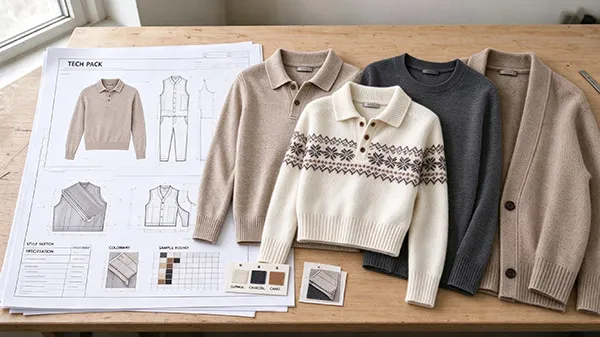
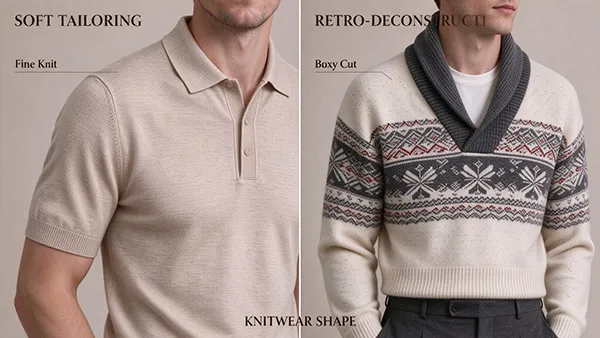
- Soft tailoring meets vintage deconstruction: High-gauge fine-gauge polos and classic Fair Isle cables are back in the main range, balancing business ease with a retro collegiate feel.
- Better materials at a workable cost: The 70/30 merino cashmere blend is becoming a mainstream option—luxury hand feel, lower pilling risk.
- Flexible low-MOQ development: Mill stock-supported yarns and planned dye-vat allocation make 50–200 piece capsule tests realistic, cutting inventory exposure.
- Full-chain compliance and traceability: EU DPP and anti-greenwashing requirements are now part of line planning. Batch-level traceability data is the baseline for overseas scrutiny.
As apparel brands and buyers plan their collections for the 2026–2027 seasons, they face a delicate balancing act. Navigating the shift toward quiet luxury and vintage-inspired aesthetics requires fresh design directions, yet commercial success hinges on solving pressing supply chain challenges: partnering with an experienced OEM knitwear manufacturer to minimize inventory risk through flexible low-MOQ production while meeting strict new EU sustainability and traceability regulations.
1. Macro Aesthetics & Silhouette Architecture (2026–2027)
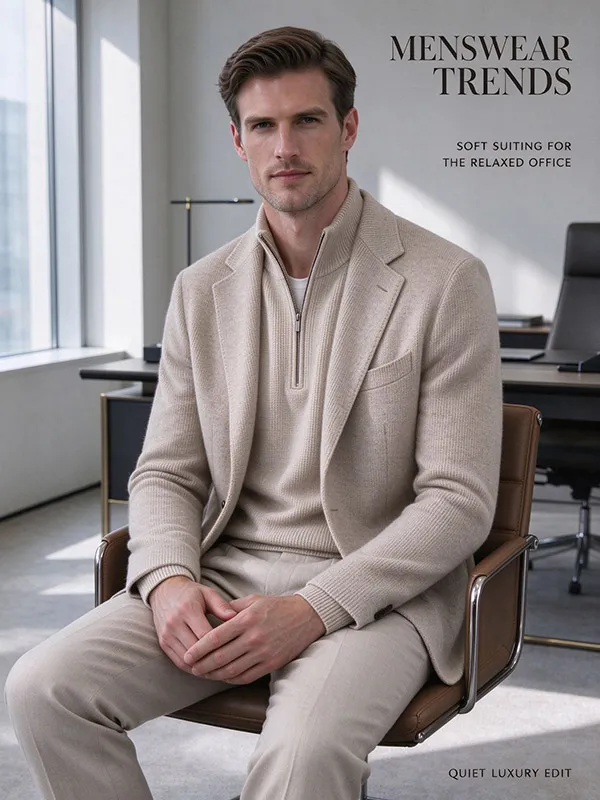
The design logic for 2026–2027 men's knitwear is undergoing a clear structural shift. Two forces sit at the center: silhouette engineering and multi-occasion wear. Buyers want higher cross-season utilization, and our sample room sees the aesthetic direction landing in four commercial lanes.
1.1 Soft Tailoring & Knitwear-as-Suiting
Business menswear is moving away from stiff woven formalwear. We recommend developing 14G to 18G fine-gauge knitwear pieces, using high-density plain jersey stitch to build a clean, self-supporting hand. Fine-gauge knit polos and unlined knit blazers can replace traditional shirts—and they travel better. The garment holds a business-ready look without losing the ease needed for commuting and travel.
1.2 Future Vintage & Classic Reinterpretation
Poetcore and old-money references are feeding into classic patterns—Fair Isle jacquard, shawl-collar cardigans, fisherman rib. The update comes through silhouette: cropped/boxy body shapes with natural dropped shoulders. This breaks the old heavy feel and gives the patterns a younger, more commercial proportion.
1.3 Quarter-Zip & Micro-Neckline Evolution
Quarter-zip pullovers have become a core evergreen. At the same time, single-button henleys and micro V-necks show strong commercial potential. Worn over a shirt or T-shirt, they open up the neckline and give a cleaner proportion—small detail, clear selling point.
1.4 Commercial Color Matrix
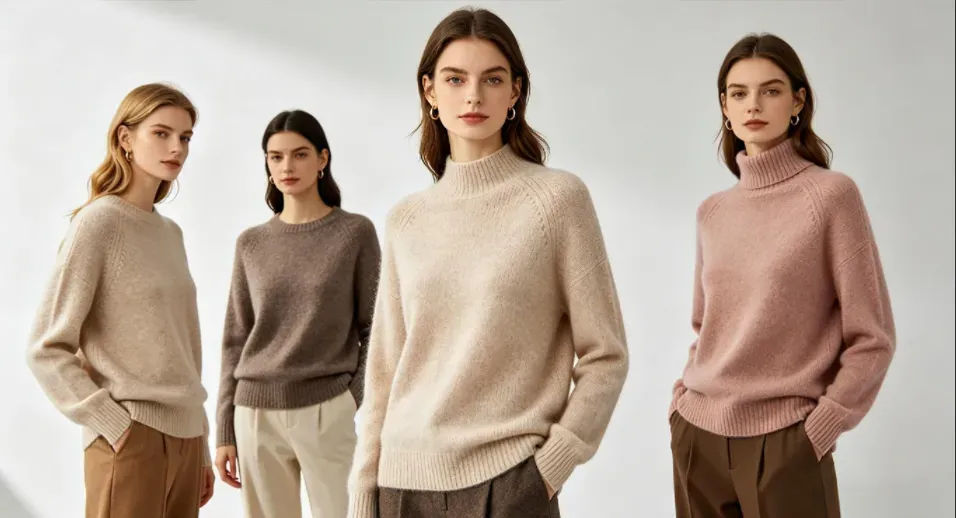
For buy planning, we suggest a 70/20/10 structure: 70% Mediterranean neutral base colors—sand, oatmeal, pearl grey, sage green—as the safe commercial floor; 20% saturated autumn/winter accents such as Bordeaux and scarlet; 10% seasonal washed and faded shades to add depth to the range.
2. Stitch Engineering & Surface Texture Innovations
In 2026–2027 men's knitwear development, stitch engineering drives both hand feel and commercial margin. Our workshop sampling shows surface texture splitting into two clear directions: cross-season lightweight textures and controlled deconstruction.
2.1 Cross-Season Lightweight Textures (SS27 & Transitional Seasons)
The core of spring/summer development is texture without heat. By adjusting transfer density on computerized flatbed machines, we turn traditional heavy cables into flat, refined cables. Pair that with micro-pointelle and lightweight bouclé—breathability stays high, and the 3D structure still reads on the shelf.
2.2 Controlled Deconstruction & Detail Premium (AW26/27)
Higher-end lines no longer rely on large-area prints. The premium comes from programmed detail: controlled distressed floats and offset ribbing, plus contrast hand-linking at the neckline and shoulder seams. This adds recognition to basic styles without a heavy cost increase.
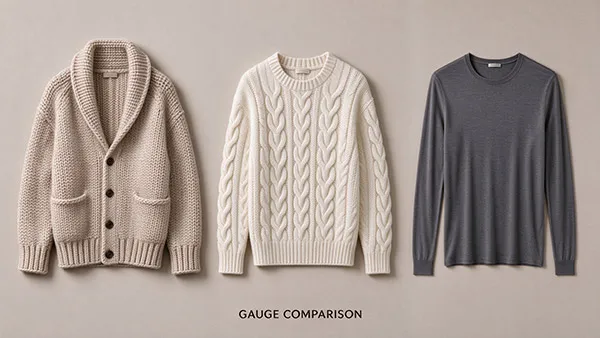
2.3 Gauge Selection Chart for Commercial Ranges
Use this chart as a starting point for gauge selection. Final garment weight will move with stitch density, yarn lot and finishing.
| Gauge Range | Core Style & Representative Items | Approx. Garment Weight | Yarn Count Spec | Drape & Structure |
|---|---|---|---|---|
| 3G–5G | Vintage chunky knits, heavy shawl-collar cardigan | 650g–900g+ | 2/16Nm–2/20Nm multi-ply | Structured, very warm, bold 3D hand |
| 7G–9G | Classic cables, fisherman rib pullover | 420g–580g | 2/26Nm–2/28Nm two-ply | Full-bodied texture, balanced body and stretch |
| 12G | Four-season basics, quarter-zip sweater | 260g–360g | 2/28Nm–2/30Nm single/two-ply | Moderate thickness; wears alone or layers |
| 14G–18G | Quiet-luxury commute base layers, fine-gauge knit polo | 160g–240g | 2/48Nm–2/60Nm high-count | Silky next-to-skin, high drape, comparable to woven suiting |
3. Yarn Science, Blending Economics & Performance
Yarn selection sets the cost structure and the return rate. For 2026–2027 men's development, we start from fiber physics—then balance hand feel against durability.
3.1 Superfine Merino vs. Cashmere: Parameter Comparison
Cashmere runs 14–16 micron with a 32–45mm staple length. It gives extreme softness, but abrasion resistance is weaker, and raw material cost is typically 3 to 4 times that of comparable merino. Superfine merino sits at 17.5–19 micron with a 60–100mm staple length. It brings natural resilience, pilling resistance, moisture management and temperature regulation—better suited to high-frequency daily commuting.
3.2 The 70/30 Golden Blend Commercial Formula
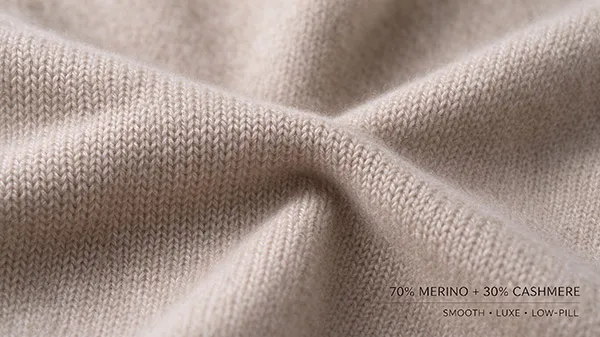
When sampling for US and European mid-to-high-end clients, we recommend the 70% superfine merino + 30% cashmere blend for technical reasons, not marketing. Merino's long staple forms the strength backbone; cashmere wraps the surface with softness. In practice, this cuts raw material cost by roughly 35%–45% and can double the garment's useful wear life.
3.3 Technical Breakthrough for Recycled Fibers
GRS-certified recycled cashmere sourcing, once mechanically opened, drops to a 24–30mm staple length. Spinning it alone easily leads to yarn breaks and pilling. For recycled cashmere sourcing, fiber length is the first thing we check. Our solution is a controlled blend with long-staple organic cotton or TENCEL™ Luxe, followed by gentle physical milling. The target is pilling grade 3–4.
4. Supply Chain Execution: MOQ Strategy & Quality Assurance
In knitwear export, design execution and bulk quality decide whether a brand reorders. We work from the supply chain floor up—helping buyers avoid development risk and hold bulk standards.
4.1 Solving MOQ and Small-Batch Flexible Development
The real MOQ bottleneck in knitwear is not the garment factory. It is the spinner's dye-vat minimums. For independent brands, we recommend starting with mill stock-supported yarns from the spinner's shade card. That removes costly custom dyeing and makes low MOQ knitwear production realistic—50–200 piece capsule collections can go to market with zero inventory pressure.
4.2 30cm × 30cm Swatch Testing Before Bulk
Do not skip the swatch and go straight to bulk. Before production, we knit a standard 30cm × 30cm swatch to lock stitch density, wash shrinkage and final hand feel. This is a small step that prevents large claims later.
4.3 Bulk Quality Control and Anti-Deformation Hard Stops
- Dimensional stability: The workshop runs at 22°C ±2°C and 65% ±5% RH. Wash shrinkage is controlled within ±3% under ISO 6330.
- Physical and chemical testing: ISO 12945-2 Martindale pilling at grade 3–4 or better, rub fastness, and lightbox shade-band approval.
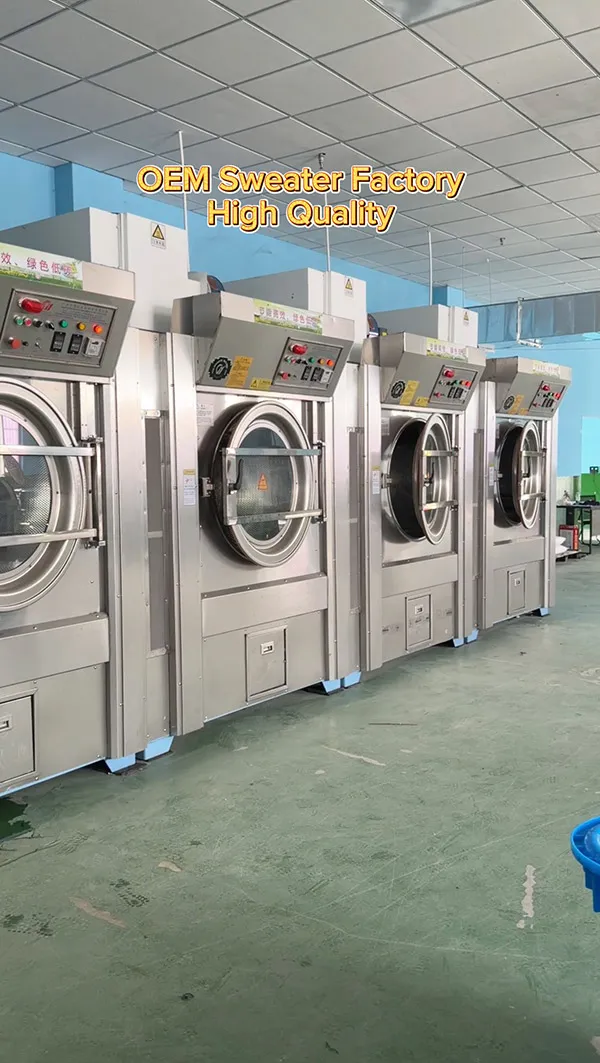
- Structure against deformation: Hand-linking replaces standard overlock at key seams. Mobilon clear elastic tape is inserted into shoulder seams and necklines to prevent hanger stretch.
- Safe delivery: AQL 2.5 inspection and 100% needle detection.
5. 2026–2027 Global Regulatory & Traceability Compliance
US and European textile regulation is tightening through 2026–2027. Supply chain transparency is now the floor for avoiding customs holds and penalties. We have built standardized compliance files on the production side to help clients handle three core reviews.
5.1 EU Digital Product Passport (EU DPP) Data Alignment
We follow the ESPR framework and the 2027 textiles delegated act timeline. For each order, we build a batch-level traceability pack: farm/raw material origin certificates, spinner batch records, dye chemical lists and garment factory process records. This gives brands the data needed to generate compliant digital labels.
5.2 Directive EU 2024/825 Compliance
The anti-greenwashing directive rules out vague “eco-friendly” claims on hangtags and care labels. We help brands separate yarn-level certification from garment-level certification, and provide verifiable GRS, RWS and OEKO-TEX® Standard 100 transaction certificates (TC). Every sustainability claim needs a document behind it.
5.3 Forced Labor Regulation and Customs Traceability
With the EU forced labor regulation (EU 2024/3015) fully applying by the end of 2027, and US customs scrutiny continuing, we maintain a closed chain of custody. Raw material purchasing, knitting and finishing are documented and auditable. That is what keeps goods moving through customs.
6. Frequently Asked Questions (FAQ)
Q1: What is the actual MOQ for a custom men's knitwear range in 2026–2027?
A: With mill stock-supported yarns, MOQ can go as low as 50–200 pieces per style, with mixed colors allowed. If you need custom Pantone dyeing, the order must match the dye-vat minimum—usually 50–100kg of yarn, roughly 150–300 garments.
Q2: Which yarn blend balances luxury hand feel and durability?
A: We recommend 70% superfine merino wool (17.5–19 micron) + 30% cashmere. Merino's long fiber gives the strength backbone and pilling resistance at grade 3–4 or better; cashmere provides the soft touch. It can reduce raw material cost by 35%–45% and extend garment wear life.
Q3: How do you prevent heavy men's cardigans from shrinking and shoulder stretch after washing?
A: We lock dimensions through three steps: a 30cm × 30cm swatch wash test before bulk, following ISO 6330 with shrinkage controlled within ±3%; high-elastic hand-linking at neckline and shoulder seams; and Mobilon clear elastic tape inside shoulder seams to stop hanger drop.
Q4: Which certifications are core for sustainable men's knitwear sold in the US and Europe in 2027?
A: To align with EU DPP and Directive EU 2024/825, recycled materials need GRS transaction certificates, merino wool needs RWS, and OEKO-TEX® Standard 100 is recommended. We provide the full batch-level traceability file at shipment to support customs clearance.
7. Conclusion & Next Steps for Your Brand
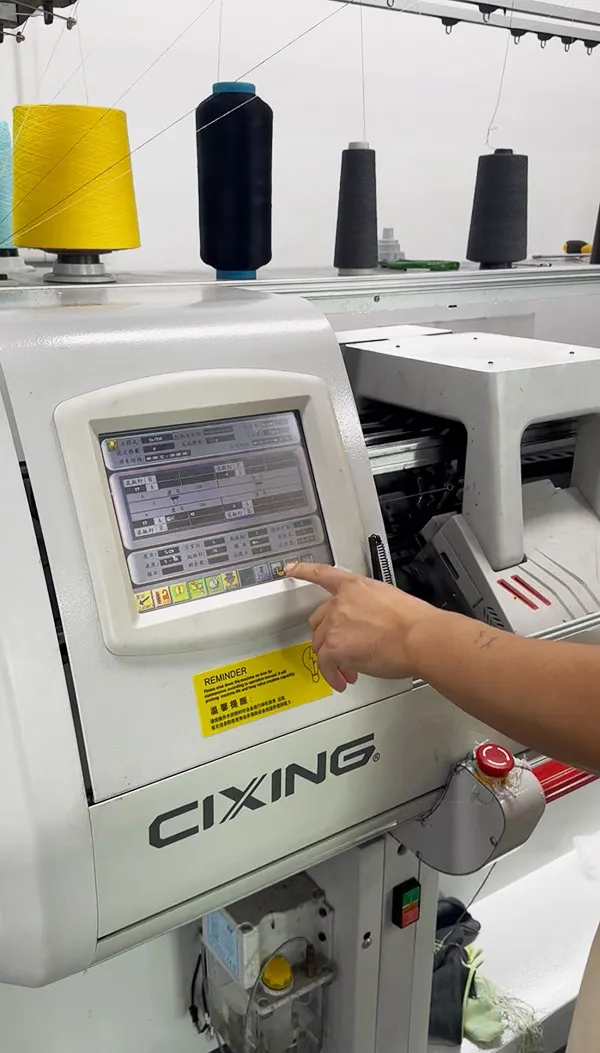
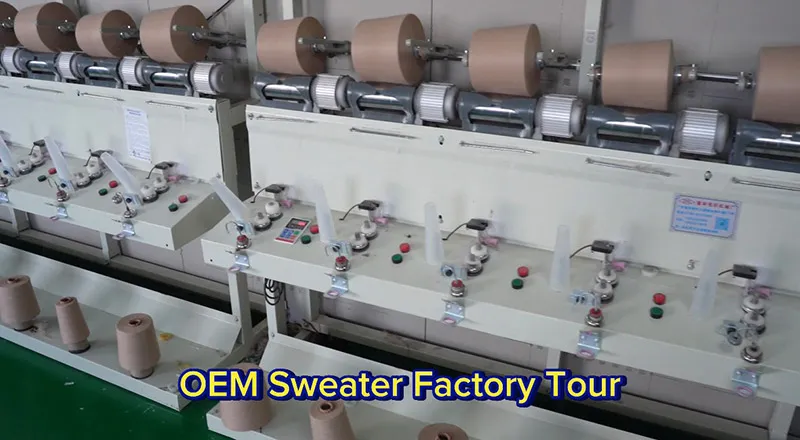
Commercial success in 2026–2027 men's knitwear depends on forward design and a supply chain that can execute it. As a custom sweater manufacturer with computerized flatbed knitting from 2G to 18G, JM Sweater helps overseas brands turn complex concepts into production-ready garments.