
Since 2024, the German Supply Chain Due Diligence Act (Lieferkettensorgfaltspflichtengesetz, LkSG) has applied to companies with 1,000+ employees. For German brands and their international sourcing arms, any human rights or environmental violation within the supply chain now carries fines of up to 2% of global annual turnover or €8 million—plus potential exclusion from public procurement. The practical consequence: German buyers no longer evaluate overseas factories on lead time and price alone. Legal traceability and mandatory compliance have become gatekeeper criteria.
As an OEM sweater supplier and B2B supply chain partner specializing in high-quality knitwear (JM Sweater), we understand the traceability pressure facing CPOs, compliance directors, and supply chain managers at German brands. Sweater production spans yarn spinning, knitting, hand-linking, and washing/setting—a multi-stage chain where hidden subcontracting, working-hour transparency, and wastewater/chemical controls can quickly become LkSG red flags.
This guide is written specifically for the knitwear and sweater category. We break down what it takes to build a risk-free supply chain that satisfies BAFA oversight—from Tier-1 to Tier-4 traceability mapping, amfori BSCI and Sedex SMETA audit deployment, OEKO-TEX® and GRS verification, through to ISO/DIN physical quality control.

1. Understanding the Legal Scope of LkSG in Apparel Sourcing
The LkSG is enforced by Germany's Federal Office for Economic Affairs and Export Control (BAFA). It eliminates the traditional assumption that importers are only responsible for Tier-1. German apparel brands are now legally accountable for human rights and environmental compliance across the entire supply chain.
Key Mandates of LkSG for German Importers
To pass BAFA's annual review, German importers must implement nine core due diligence obligations:
- Risk management system: Designate a compliance officer to oversee overseas supply chains.
- Regular risk analysis: Assess supplier human rights and environmental risks annually.
- Corporate policy statement: Communicate compliance red lines to partner factories.
- Preventive measures: Embed compliance clauses into purchase contracts; conduct regular factory audits.
- Corrective actions: Require time-bound CAP (Corrective Action Plans) upon finding violations.
- Grievance mechanism: Factories must establish an independent, anonymous complaint channel.
- Indirect supplier investigation: Initiate targeted investigations into higher-risk upstream tiers (Tier-2/3).
- Documentation retention: All compliance evidence and audit reports must be kept for at least 7 years.
- Public compliance reporting: Submit annual reports to BAFA and publish them publicly.
The "Trickle-Down Effect" on Tier-1 and Tier-2 Overseas Factories
Although LkSG enforcement targets German companies, buyers transfer compliance pressure downstream through purchase contracts:
- Mandatory Code of Conduct (CoC) signing: Violation constitutes a fundamental breach—buyers can cancel orders and claim damages.
- Audit scope extends to Tier-2 (yarn & washing): We must present GRS/GOTS certificates from upstream spinners and wastewater discharge permits from washing operations.
- Unauthorized subcontracting strictly prohibited: Linking and sewing must be completed in BSCI/Sedex-audited registered workshops—eliminating the risk of unregistered small-scale operations.
2. High-Risk Vulnerabilities in Knitwear & Sweater Manufacturing
Sweater manufacturing involves a long process chain with strong seasonality—making it particularly prone to compliance blind spots during LkSG audits. Understanding the shop-floor realities of sweater production is the key to avoiding them.
Human Rights & Labor Compliance in Seasonal Production
Overtime transparency and fair wages: For the peak delivery season (May–October), we align digital attendance records directly with bank transfer records—ensuring overtime hours comply with legal limits and overtime pay calculations (1.5x / 2.0x) are clearly traceable.
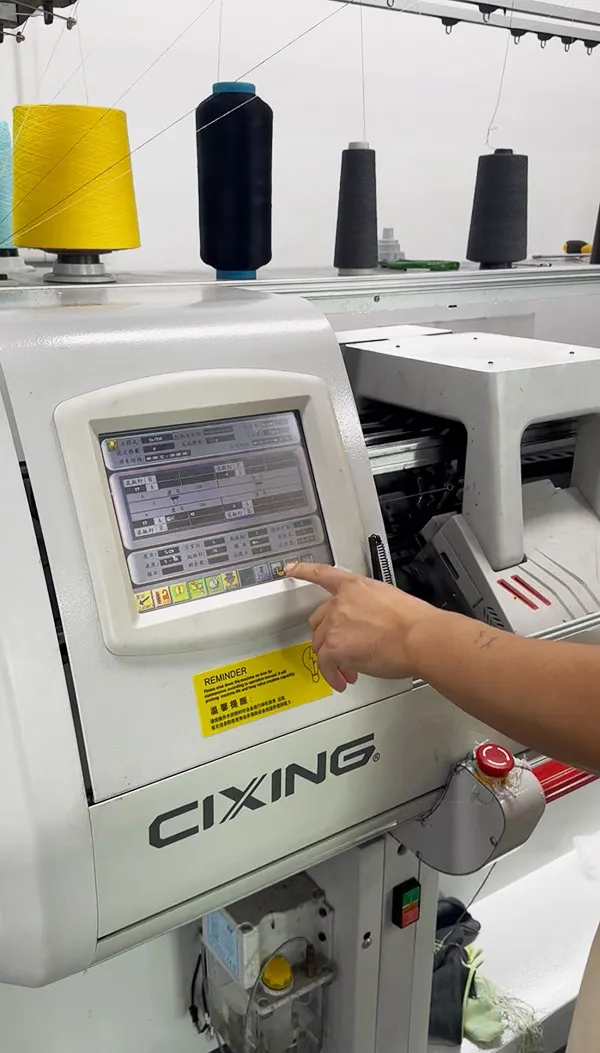
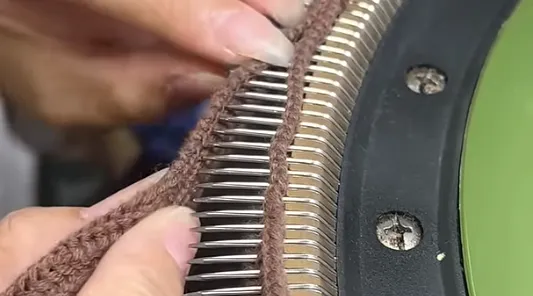
Occupational health & safety (OHS): In Stoll automated flat-knitting and linking workshops, we deploy central lint and dust extraction systems to reduce airborne fiber concentration. All linking machines and sewing stations are fitted with needle guards. In the finishing and steaming area, pipes are insulated and high-capacity ventilation with cooling is installed.
Environmental & Chemical Management in Washing & Dyeing
Wet processing compliance: Wastewater from sweater hand-feel setting and anti-shrinkage treatment must pass through a compliant effluent treatment plant (ETP), with discharge test reports on file.
REACH & ZDHC chemical standards: Full compliance with EU REACH regulations and the ZDHC Manufacturing Restricted Substances List (MRSL). APEOs, heavy metals, and PFAS are strictly prohibited. Every finished garment passes third-party toxicological testing.

3. International Certification Matrix: Aligning Factory Audits with LkSG
Under LkSG scrutiny, verbal commitments carry no legal weight. German buyers need authoritative third-party certification to evaluate overseas knitwear factories on human rights, labor rights, chemical safety, and environmental traceability.
Third-Party Audit Requirements for German Buyers
To help brand CPOs and compliance teams assess factory qualifications efficiently, here is the certification matrix German buyers most commonly request from LkSG compliant sweater manufacturers—along with the acceptance benchmarks:
| Certification / Standard | Focus Area | LkSG Compliance Impact | German Buyer Acceptance Benchmark |
|---|---|---|---|
| amfori BSCI | Social & Labor | Demonstrates no forced labor/child labor; ensures fair wages and OHS | Grade A or B (Grade C requires a CAP with remediation within 12 months) |
| Sedex SMETA (4-Pillar) | Labor, Health, Ethics, Environment | Provides deep transparency into business ethics, environmental, and labor operations | Full audit report with all non-conformities closed out |
| OEKO-TEX® Standard 100 | Chemical Safety | Verifies no harmful substances from yarn through to buttons | Class I (baby) or Class II (direct skin contact) certificate |
| GRS (Global Recycled Standard) | Material Sustainability | Verifies full chain-of-custody for recycled wool/polyester yarns | Valid Scope Certificate (SC) + matching Transaction Certificate (TC) per batch |
| HIGG Index (FEM/FSLM) | Carbon & Environmental Impact | Provides quantifiable carbon and water data for BAFA annual reporting | Verified completion and uploaded to Higg platform |
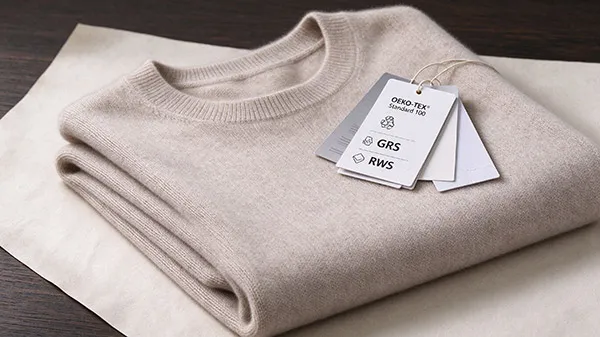
At JM Sweater, we maintain and regularly update these third-party audit and product certifications—ensuring German partners can retrieve complete, compliant, and verifiable documentation within hours when facing BAFA spot checks or internal ESG audits, positioning us as your trusted BSCI OEKO-TEX certified knitwear factory.
4. End-to-End Traceability: From Yarn Fiber to Finished Sweater
Under LkSG, the compliance gap German buyers fear most is a "broken chain of transparency." Sweater production involves multiple collaborating processes—and in traditional supply chains, unauthorized subcontracting and untraceable raw materials are common. Both constitute high-risk violations in BAFA reviews.
To deliver full traceability and legal risk mitigation, we've built a chain-of-custody management system spanning Tier-4 raw fiber through to Tier-1 finished garment delivery:
Mapping Tier-1 to Tier-4 Supply Chain Transparency
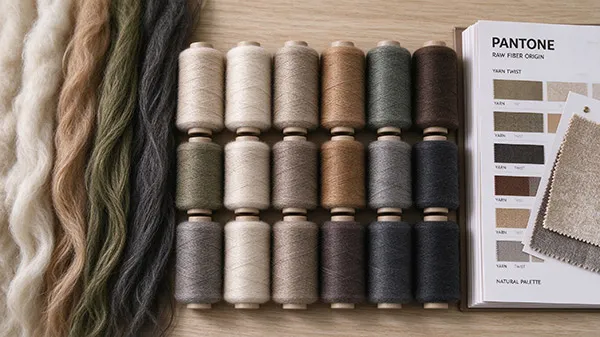
Raw Fibers & Origin Control
Wool & Cashmere: Strict animal welfare standards enforced. We source exclusively RWS (Responsible Wool Standard) certified wool and confirm mulesing-free credentials at the fiber origin—eliminating human rights and animal welfare controversies at the source. This is what German buyers should expect from a mulesing-free RWS merino wool sweater supplier.
Organic Cotton: GOTS (Global Organic Textile Standard) certified cotton, with no sensitive origin risk and no chemical pesticide residue.
Yarn Spinning & Dyeing Verification
Environmental & safety verification: Partner spinners must present valid OEKO-TEX® Standard 100 certification—confirming no harmful chemicals are introduced during spinning or dyeing.
GRS Transaction Certificates (TC): For recycled wool or recycled polyester yarns, a matching GRS TC is issued per batch—enabling account-balance traceability from the recycling point to the spinning mill.
Main Factory: Knitting, Linking & Finishing
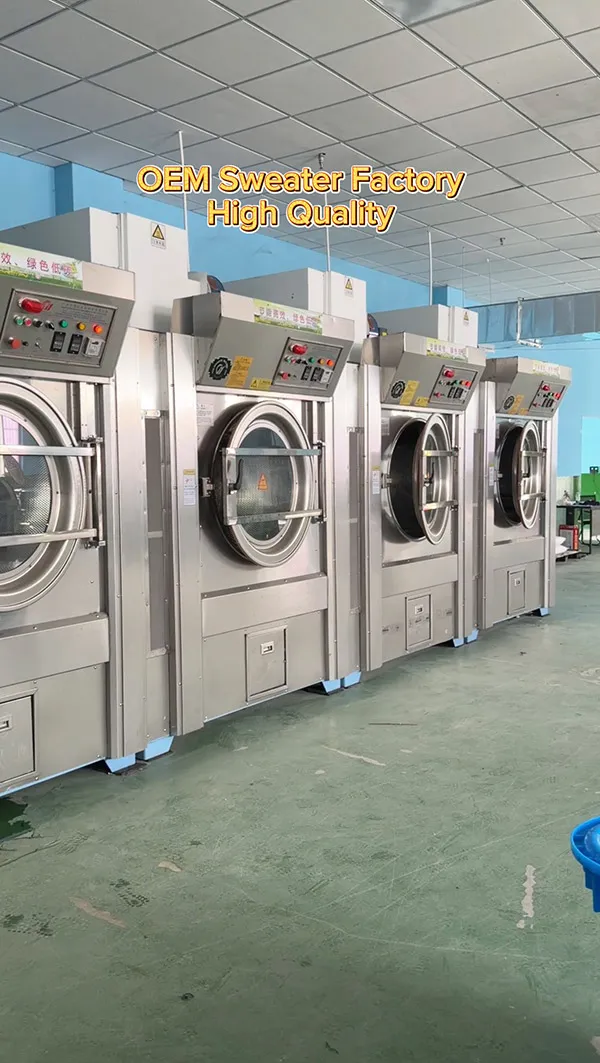
100% audited-workshop production (anti-unauthorized subcontracting): Hand-linking and sewing in sweater manufacturing are the processes most easily hidden away to unqualified small workshops. At JM Sweater, all knitting, linking, finishing, and washing operations are completed 100% within our BSCI/Sedex-audited main facility. No unregistered underground subcontracting. German brands receive a fully verifiable, garment-level transparent production record ensuring absolute German Supply Chain Act knitwear compliance.
5. Engineering Quality Standards: Why Durability is Key to German Compliance
In the German buyer's engineering mindset, product durability is sustainability. A sweater that pills and loses shape after a few wears is wasted resources—directly contradicting LkSG and EU ESG environmental principles. Translating physical quality metrics into compliance risk data is how you earn trust from technically-minded German buyers.
DIN & ISO Quality Benchmarks for Premium Knitwear
To meet German market requirements for high quality and long service life, we adhere to the following DIN/ISO physical testing standards:
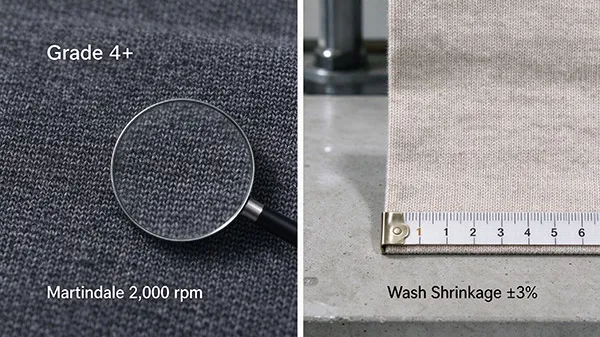
- Anti-pilling performance (ISO 12945-2 Martindale Method): After Basolan anti-shrink and anti-pilling wash treatment, high-gauge worsted wool and cashmere sweaters are tested to 2,000 rubs. Pilling grade consistently achieves Grade 4+ (5-point scale). This is the ISO 12945 Grade 4 anti-pilling standard that German buyers should specify in their tech packs.
- Dimensional stability after washing (ISO 6330 / ISO 5077): Simulating European standard home laundering and flat-dry procedures. Length and width shrinkage controlled within ±3%—garments retain shape through repeated washing.
- Abrasion resistance & colorfastness (ISO 105 Series): Dry rub fastness 4–5; wet rub and light fastness (ISO 105-B02) Grade 4+. Color bleeding and staining disputes eliminated.
- Final inspection (DIN ISO 2859-1): Bulk delivery follows strict AQL sampling. Major 2.5 / Minor 4.0 acceptance thresholds. This AQL 2.5 knitwear inspection protocol ensures batch-level quality consistency.
6. Your LkSG Compliance Dossier: Partner Checklist
To help German buyers and compliance teams complete supplier onboarding efficiently, JM Sweater packages all factory compliance evidence and test data into a standardized German Compliance Media Kit—ready for retrieval at any time, including during BAFA spot checks.
The 7-Point Compliance Media Kit for German Buyers
- amfori BSCI (Grade A/B) / Sedex SMETA reports: Covering human rights, wage transparency, and OHS audit records.
- OEKO-TEX® Standard 100 and GRS certificates: Non-toxic chemical certification plus full-chain GRS Transaction Certificates for recycled yarns.
- Signed CoC and LkSG commitment letter: Official declaration of human rights and environmental legal responsibility.
- REACH and ZDHC Safety Data Sheets (SDS): Washing auxiliaries fully compliant with EU chemical restrictions.
- SGS / TÜV third-party test reports: ISO 12945 (anti-pilling Grade 4+) and ISO 6330 (shrinkage within ±3%) data.
- Factory grievance mechanism documentation: LkSG-compliant worker complaint channel SOP and on-site evidence.
- Anti-subcontracting policy declaration: Commitment that knitting and linking are 100% completed in audited main facilities.
Why JM Sweater is Your LkSG-Compliant Knitwear Manufacturing Partner
JM Sweater specializes in mid-to-high-end sweater and knitwear export. Our facility runs 110 German Stoll automated flat-knitting machines (3GG–18GG, including 3D WholeGarment® seamless capability, annual capacity 1.2 million pieces). We integrate hard textile engineering with rigorous international compliance across every process.
The factory maintains amfori BSCI and Sedex SMETA audit qualification. Products are fully aligned with OEKO-TEX® Standard 100, GRS traceability certification, and ISO 12945 (anti-pilling Grade 4+) and ISO 6330 (shrinkage within ±3%) physical testing standards. All processes are completed 100% within audited main facilities—no unauthorized subcontracting.
We understand the traceability pressure German buyers carry under LkSG. Whether responding to a BAFA spot check or an internal brand audit, we can rapidly provide the complete evidence chain—third-party audit reports, environmental certifications, and ISO physical test data—so you can build a robust, transparent German knitwear supply chain with no legal exposure.
📥 Request Our Complete Sweater Sourcing & Sample Kit
Evaluating or developing your next knitwear collection? Contact our team to request physical sample kits, explore our latest seasonal styles, or discuss your upcoming sweater manufacturing project.
Request Sample Kit / Contact Sourcing Team