
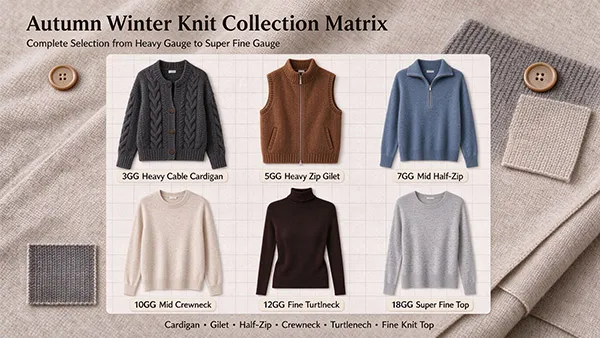
For European buyers and brand product managers, the most persistent pain point when developing autumn/winter knitwear lines is rarely the silhouette itself—it is the physical balance between gauge, yarn count, fabric weight, and drape.
As an oem sweater manufacturing partner with years of hands-on knitwear export experience, we consistently observe on the factory floor: chasing low unit costs or blindly following a trending stitch structure almost always leads to garment hang-stretch deformation, linking seam blowouts, or failure to meet the thermal and lightweight standards of different European regions.
From Nordic Iceland to the Southern Mediterranean, European regional markets impose vastly different and stringent requirements on knitwear fabric weight and thermal insulation tiers. This article systematically deconstructs the complete 3GG to 18GG selection logic across five dimensions—flat-knitting machine gauge physics, yarn count matching algorithms, European regional micro-climate demands, gauge-specific pitfall guides, and production cost control—so your technical design and sourcing teams can make the most precise engineering decisions at the sampling stage—achieving first-pass precision and cutting development lead times.
1. Technical Foundations: Machine Mechanics & Gauge Physics
For brand Technical Designers and sourcing managers, the first step in developing an A/W knitwear line is understanding the mechanical balance between flat-knitting machine gauge and yarn physical properties. Gauge not only determines fabric thickness and weight—it directly affects garment shrinkage, resilience, and bulk production stability.
1.1 What Does "Gauge" (GG) Actually Mean in Flat Knitting?
In computerized flat knitting, Gauge (GG) is physically defined as the number of needles distributed per 1 linear inch (2.54 cm) on the needle bed.
Needle Pitch & Spatial Geometry:
- 3GG: Needle pitch approximately 8.47 mm. Wide needle slots accommodate high-bulk coarse yarns or multi-ply folded yarns.
- 18GG: Needle pitch only 1.41 mm. Extremely high demands on needle precision and yarn evenness.
Tension Control Differences Between Stoll and Shima Seiki Across Gauge Ranges
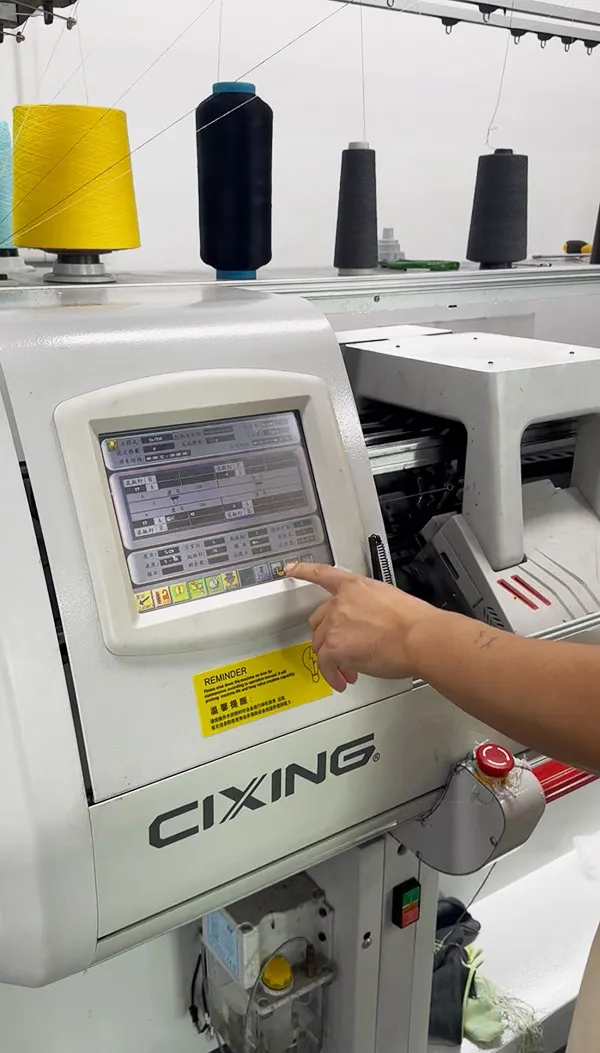
- Coarse gauge knitting (3GG–5GG): Large loops, high friction. Stoll's robust sinker system and high-torque motors deliver strong presser grip when pulling heavy Aran Cables and Full Cardigan structures—loops stay tight and resist pull-out.
- Fine gauge knitting (14GG–18GG): Micro loops; tension fluctuation easily causes yarn breakage or drop stitches. Shima Seiki employs micro needle hooks and dynamic tension path bends for low-tension smooth yarn feeding; Stoll's Dynamic Stitch system detects loop resistance in real time and micro-adjusts bend depth, ensuring high-density jersey flatness and consistent physical shrinkage.
1.2 The Engineering Math: Matching Yarn Count (Nm) to Gauge
Knitting fine yarn on a coarse gauge produces sparse, snag-prone fabric; knitting coarse yarn on a fine gauge causes needle-bed jamming and board-stiff hand feel. Knitting engineers commonly apply the empirical knitwear yarn count to gauge calculation formula:
Single-Ply Coarse Yarn vs. Multi-Ply Folded Yarn
- Single-ply coarse yarn (e.g., 1/3.5 Nm): Natural rugged character and fiber halo, high bulk, but uneven twist distribution easily causes torque/skewing in single jersey—requires strict control during washing.
- Multi-ply folded yarn (e.g., 6-ply 2/28 Nm for 3GG): Reverse-twisted fine yarns significantly improve tensile strength and yarn evenness; loops are full and well-defined, with far superior abrasion resistance and anti-pilling performance compared to single-ply coarse yarn.
1.3 Quick Reference: Yarn Count & Gauge Compatibility Table
| Machine Gauge | Physical Needle Pitch | Recommended Single/Plied Yarn Count (Nm) | Target Total Nm | Standard Fabric Weight (g/m²) | Physical Structure & Typical Application |
|---|---|---|---|---|---|
| 3GG | 8.47 mm | 4–6 ply 2/28 Nm or 1/3.5 Nm coarse yarn | Nm 1.5 - 2.5 | 550 - 850+ | Heavy coarse-gauge cables, fisherman rib, cold-weather outerwear |
| 5GG | 5.08 mm | 3–4 ply 2/28 Nm or 2-ply 2/16 Nm | Nm 3.5 - 5.0 | 420 - 600 | 3D textured outerwear, 3D cables, chunky cardigans |
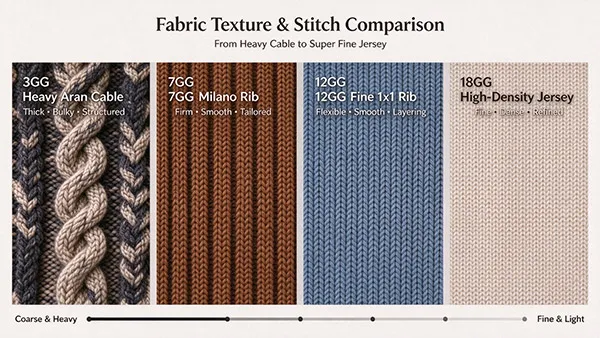
| 7GG | 3.63 mm | 2-ply 2/28 Nm or 1-ply 2/16 Nm | Nm 6.0 - 8.5 | 320 - 450 | General commercial volume drivers, classic Milano rib, waffle stitch |
| 10GG | 2.54 mm | 1-ply 2/24 Nm to 2/28 Nm | Nm 10.0 - 13.0 | 240 - 350 | Mid-weight business commuter knits, half-zip pullovers |
| 12GG | 2.12 mm | 1-ply 2/28 Nm to 2/36 Nm | Nm 14.0 - 18.0 | 180 - 280 | Worsted V-neck sweaters, business base layers, slim-fit cardigans |
| 14GG | 1.81 mm | 1-ply 2/36 Nm or 2/48 Nm | Nm 18.0 - 24.0 | 150 - 220 | Early-autumn lightweight knits, high-gauge knit dresses, formal inner layers |
| 16GG / 18GG | 1.41 mm | 1-ply 2/60 Nm to 2/80 Nm ultra-fine yarn | Nm 28.0 - 40.0+ | 90 - 160 | Luxury skin-contact layers, silk-cashmere base T-shirts, high-density jersey |
2. European Autumn/Winter Market & Micro-Climate Demands
European buyers do not purchase "generic A/W knitwear." Given the stark temperature differentials and lifestyle patterns across geographic regions, brand sourcing managers must plan gauge selection strictly around target micro-climate and retail drop scheduling.
2.1 Regional Climate Segmentation & Buyer Preferences
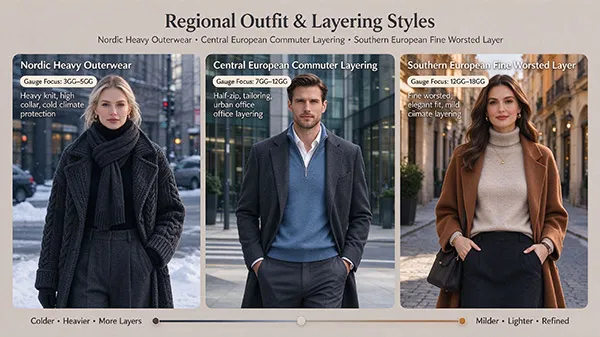
Nordic & Baltic Region (Sweden, Norway, Finland, Denmark)
- Primary gauge range: 3GG–7GG
- Climate & design requirements: Long extreme-cold winters and strong outdoor winds demand heavy insulated coats, Aran Cables, and bulky mohair. Fabric weight must be substantial (420–850 g/m²), typically using 100% RWS wool or heavy woolen-spun yarns.
Central Europe, UK & Benelux (Germany, France, UK, Netherlands, etc.)
- Primary gauge range: 7GG–12GG
- Climate & design requirements: Rainy, humid, with well-heated interiors—layering systems are paramount. 7GG Milano rib and 10GG/12GG half-zip styles dominate, balancing urban commuter warmth with indoor take-off convenience.
Southern Europe (Italy, Spain, Portugal, Greece)
- Primary gauge range: 12GG–18GG
- Climate & design requirements: European autumn winter sweater gauge specifications tailored for mild winters emphasize high-density breathability, silky drape, and indoor elegance. Worsted merino and silk-cashmere base layers lead, requiring excellent skin-contact comfort and anti-pilling performance.
2.2 Seasonal Drop Strategy: Early Autumn vs. Peak Deep Winter
European retail brands follow a clear "decreasing gauge / increasing fabric weight" logic across drops:
- Drop 1 (August–September, early autumn transition): 14GG–18GG lightweight jersey and high-gauge polo shirts—fast sell-through to test market color palettes.
- Drop 2 (October, golden autumn): 10GG–12GG versatile commuter knits—capturing the bulk of autumn commercial sales.
- Drop 3 (November–December, deep winter): Full rollout of 3GG–7GG heavy cables and insulated cardigans—locking in Christmas and high-ticket deep-winter volume orders.
- Drop 4 (January–February, New Year transition): Shift to 12GG–14GG luxury cashmere and cross-season value base layers, bridging smoothly into early spring.
3. Deep-Dive Gauge Classification & Manufacturing Matrix
3.1 Coarse & Heavy Gauge (3GG – 5GG): Statement Outerwear & Chunky Texture
- Fabric weight range: 420 g/m² – 850+ g/m² (garment weight approx. 600g – 1100g).
- Applicable stitch structures: Aran Cables, Fisherman Rib, Full Cardigan, Brushed Mohair.
- Manufacturing pitfall guide:Fine gauge vs heavy gauge sweater manufacturing principles dictate that coarse-gauge open mesh is snag-prone—must be knitted at tight stitch tension density. Garments under hang-weight are highly susceptible to elongation and deformation; shoulder seams must be reinforced with Mobilon clear spandex tape or twill tape for shape retention. Products are volumetric shipments—plan compressed sea-freight packing in advance to control volumetric shipping weight costs.
3.2 Mid-Gauge Commercial Workhorse (7GG – 10GG): The Core Volume Drivers
- Fabric weight range: 250 g/m² – 450 g/m².
- Applicable stitch structures: Milano Rib, Ottoman, Intarsia, Waffle Stitch.
- Factory scheduling advisory: This range represents the highest-volume universal workhorse for European commercial brands. Annual capacity peaks April–August; European buyers must secure flat-knitting machine slots early.
3.3 Fine Gauge Executive Layering (12GG – 14GG): Tailored Precision
- Fabric weight range: 180 g/m² – 300 g/m².
- Applicable stitch structures: Stockinette Jersey, 1×1 / 2×2 Fine Ribbing, Pointelle.
- Quality control essentials: Must be equipped with 12pt/14pt linking machines and experienced operators to avoid bulky seams or holes at necklines and underarms. Worsted low-twist yarns require Basolan anti-pilling treatment to achieve ISO Grade 4 anti-pilling standard.
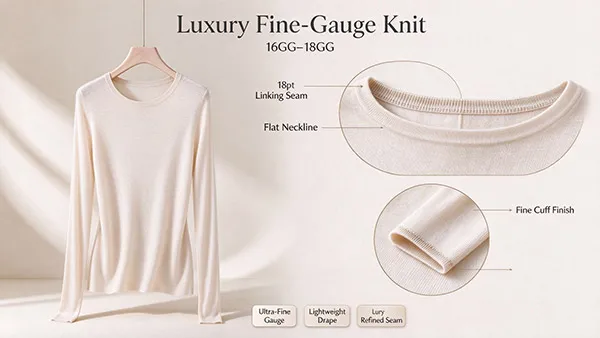
3.4 Ultra-Fine & Luxury Gauge (16GG – 18GG): Skin-Contact Elegance
- Fabric weight range: 90 g/m² – 160 g/m².
- Applicable stitch structures: High-density Jersey, Micro-plating.
- Technical threshold: Requires temperature- and humidity-controlled workshop operation, equipped with Memminger positive yarn feeders to prevent yarn breakage and drop stitches. 18pt–20pt high-gauge hand linking is time-intensive with elevated labor costs—suited for high-premium luxury base-layer collections.
4. B2B Sourcing Economics: Cost, Knitting Speed, and Defect Control
For apparel brand sourcing directors, gauge selection is not merely a style decision—it is a commercial calculation involving total cost, machine capacity, and first-pass yield.
4.1 Production Efficiency & Knitting Time Breakdown
Knitting time per panel varies dramatically across gauge ranges:
- Coarse gauge (3GG–5GG): Single panel knitting requires only 10–15 minutes. Wide needle pitch and coarse yarn deliver high gram-per-minute output; daily machine throughput is high.
- Ultra-fine gauge (16GG–18GG): Extremely high loop density per square centimeter; single panel knitting takes 60–90 minutes. Machines run at low speed to prevent yarn breakage—capacity cost rises significantly.
4.2 Material Cost vs. Labor Cost Trade-Off
- Coarse-gauge heavy-weight cost structure: Cost is primarily driven by raw material weight (600g–1000g+ wool/alpaca per garment); yarn budget share is high, but linking labor is relatively straightforward.
- Ultra-fine gauge luxury cost structure: Raw material usage is low (120g–250g), but cost shifts to machine depreciation, time-related wear, and high-skill linking operator labor hours.
4.3 Quality Control & Defect Prevention
- Fine-gauge inspection standard: 16GG–18GG is highly prone to micro dropped stitches or yarn breakage; workshop must inspect every garment under professional high-intensity light inspection tables to guarantee delivery quality.
- Coarse-gauge QC focus: Stoll flat knitting machine gauge matching and 3GG–5GG machine tension uniformity testing are critical—preventing cable misalignment or edge curling caused by localized yarn feed slack.
5. Step-by-Step Gauge Selection Checklist for Tech Pack Development
Before converting design drawings into bulk production, brand Technical Designers need a standardized engineering evaluation path to ensure first-pass sampling and locked costs.
5.1 The 5-Step Evaluation Framework for Technical Designers
- Define target climate and retail drop: Specify retail region (e.g., Nordic insulation vs. Southern European transition) and Drop 1–4 launch window.
- Lock target fabric weight: Specify target g/m² based on style positioning (heavy outerwear 550+g or lightweight base layer 150g).
- Back-calculate yarn count and ply: Use the Total Nm formula to calculate required yarn specification and plying scheme.
- Match machine gauge: Custom knitwear factory gauge capabilities allow selecting optimal needle pitch from 3GG–18GG and verifying factory machine fleets (Stoll / Shima Seiki).
- Swatching physical validation: Knit 10cm × 10cm stitch gauge swatch and conduct pre/post-wash shrinkage testing.
5.2 Pre-Production Checklist Before Sample Order
Before submitting a tech pack or placing a sample order with JM Sweater, verify the following 6 critical sweater tech pack pre-production checklist parameters:
- Target Fabric Weight (target g/m² and garment unit weight tolerance)
- Machine Gauge (GG) (flat-knitting machine gauge and needle pitch selection)
- Yarn Composition & Count (fiber composition and exact Nm)
- Stitch Tension Level (loop knitting density tightness requirements)
- Linking Dial Gauge (linking machine gauge matching, e.g., 14pt)
- Washing & Finishing Specs (milling, anti-pilling, and hand-feel wash standards)