
For children’s knitwear bound for the U.S. market, flammability compliance isn’t optional—it’s a hard stop if the paperwork doesn’t line up. CPSC enforcement tends to be straightforward: missing test records, mislabeled fiber content, or a failed burn test can hold a container at the port, pull an Amazon listing, or trigger a recall that eats an entire season’s margin. These aren’t hypotheticals; they happen every quarter.
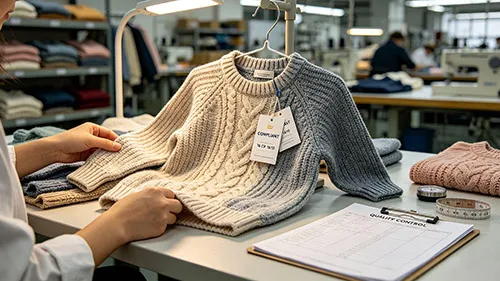
From JM Sweater’s two decades of shipping children’s knits to the U.S.—these notes cover the practical side of 16 CFR 1610 versus 1615/1616: which tests can be legally skipped, which finishing steps create hidden risk, and what customs actually checks in the shipping documents.
| Item | 16 CFR 1610 (General Apparel Flammability) | 16 CFR 1615 / 1616 (Children’s Sleepwear) |
|---|---|---|
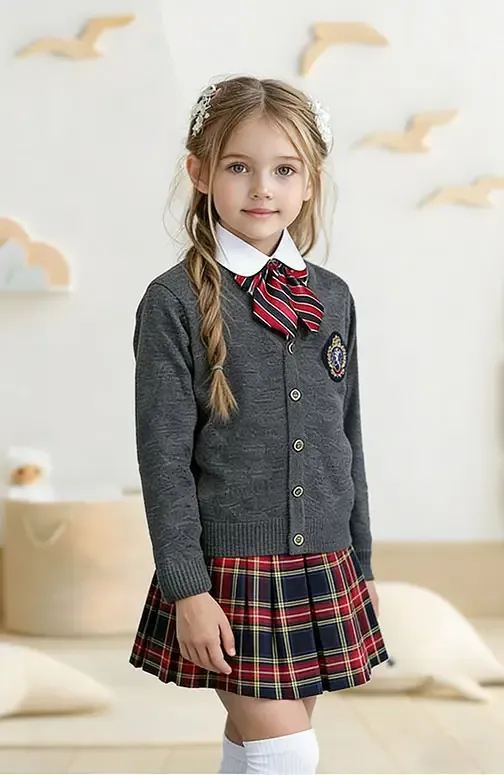
| Applicable Garments | Daily children’s sweaters, cardigans, pullovers, outer knit layers | Children’s sleepwear, pajamas, nightgowns |
| Classification Trigger | Garment characteristics + marketing wording | Any product marketed for sleeping or napping |
| Available Exemptions | Fiber composition exemption / fabric weight exemption | No exemptions applicable |
| Standard Test Method | Horizontal flammability test | Strict vertical burn test |
| Primary Compliance Risk | Improper marketing language leads to reclassification | Most untreated knit fabrics fail testing |
| Flame Retardant Rule | Flame retardant chemicals not mandatory | Often required unless tight-fitting design is adopted |
Why a standard cardigan can get reclassified as sleepwear
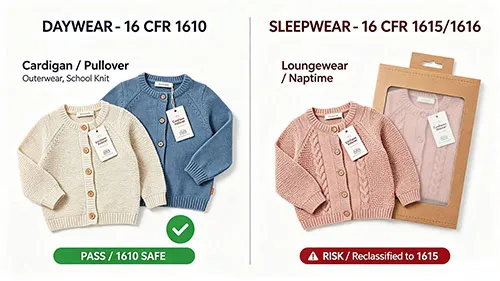
Last year, a shipment of cotton-ribbed cardigans cleared 1610 testing at the factory but got held at the U.S. port. The reason: the Amazon listing used “cozy loungewear” and the hangtag mentioned “perfect for naptime.” CPSC read that as sleepwear, reclassified the goods under 1615/1616, and the vertical burn test failed within seconds.
The rule here is about marketing language, not just the garment itself. Product titles, bullet points, hangtag copy, poly-bag graphics—anything that suggests sleep or lounging—can trigger reclassification. Words like loungewear, home wear, sleep sweater, nap top, or even icons of beds or pillows are enough. For everyday knits, packaging and online copy should stay within daytime descriptors: cardigan, pullover, school knit, outer layer. The factory flags any customer copy that crosses that line before production starts.
16 CFR 1610 – when testing is required and when it's exempt
| Exemption Type | Qualifying Conditions | Disqualifying Factors | Mandatory CPC Documentation Requirement |
|---|---|---|---|
| Fiber Content Exemption §1610.1(d)(1) | Garment made of 100% or blended wool, acrylic, polyester, nylon, modacrylic, olefin | Contains cotton, rayon or linen in any percentage | Clearly state fiber composition and cite exact clause |
| Fabric Weight Exemption §1610.1(d)(2) | Flat non-raised knit (jersey, rib, interlock) ≥ 2.6 oz/yd² | Brushed, napped, chenille, mohair raised-surface fabrics | Record fabric weight, fabric structure and clause reference |
Most everyday children’s knits don’t actually need a lab burn test. Two clear exemptions exist, and they’re used regularly—provided they’re documented correctly on the CPC.
Exemption 1 – fiber content: If the finished fabric is 100% wool, acrylic, polyester, nylon, modacrylic, or olefin, or a blend exclusively of those fibers, no test is needed. Any cotton, rayon, or linen content voids this exemption. Every yarn lot is checked for composition—even 5% cotton can disqualify a whole batch.
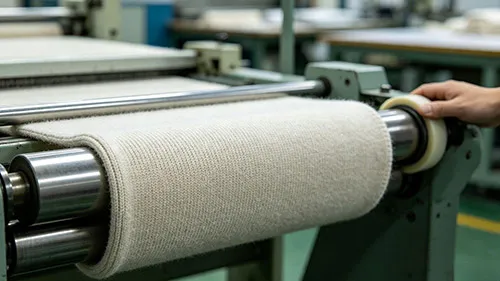
Exemption 2 – weight for plain surfaces: For flat, non-raised knits (jersey, rib, interlock), a fabric weight of 2.6 oz/yd² (approx. 88 g/m²) or more exempts the garment from testing. Most medium- to heavy-gauge kids’ sweaters exceed this, so the exemption covers a large portion of production. Each fabric roll is weighed and recorded before cutting.
The real risk sits with raised-surface fabrics—brushed, napped, mohair-style, or chenille. Those can't use the weight exemption, and if they contain cotton or rayon, they must go to a CPSC-accredited lab (SGS, Intertek, BV, etc.). For raised surfaces, a surface flash under 4 seconds that ignites the base fabric results in a Class 3 rating—banned from sale with no practical fix after production.
Yarn selection and finishing adjustments that reduce burn risk
Instead of relying on chemical flame retardants (which add cost and wash out over time), the factory manages flammability through yarn choice and knit structure.
For brushed or fleece-finish kids’ styles, yarns with at least 30% acrylic or a wool blend are recommended. Acrylic melts and pulls heat away; wool forms a char layer that slows flame spread. Pure cotton or rayon on a raised surface is high-risk—an in-house burn screening is run on every new raised-surface style before committing to bulk.
Stitch density and brush depth are also controlled. Loose, open gauges trap oxygen and accelerate burning. Tighter stitches and shorter, denser pile reduce surface flash. Production parameters are recorded per style and re-verified with each new yarn lot.
Finishing chemistry matters too. Some silicone-based softeners act as accelerants. The factory switched to a certified low-flammability softening system across all kids’ lines, and finished garments—not just greige fabric—are checked after washing, because dyeing, brushing, and final washing all change burn behavior.
Two documents that clear customs without delays
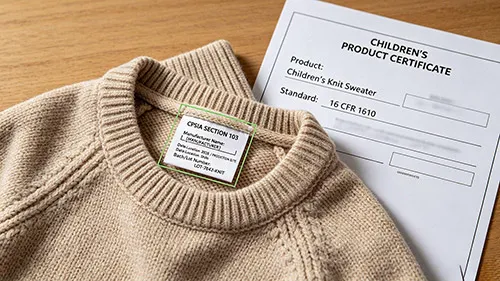
CPC Certificate – issued by the U.S. importer, but the factory provides all underlying data. If an exemption is claimed, the certificate must cite the exact clause: 16 CFR § 1610.1(d)(1) or (d)(2). Vague language like “passes flammability” isn’t accepted. If lab testing was done, the report number, lab name, and test date must be listed. Supplier test reports on yarn alone are not accepted—CPSC requires testing on the finished garment or a production-representative pre-production sample.
Tracking Label – under CPSIA Section 103, a sewn-in label must include manufacturer name, production location (city and country), month/year of production, and a batch/lot number that ties back to specific production records. The batch code must link to raw material checks and test reports. Generic codes aren’t sufficient.
Three common questions from buyers
Q: A 100% cotton plain pullover weighs over 2.6 oz—does it still need a lab test?
No—the weight exemption applies. But the CPC must explicitly reference that clause. If the certificate says “tested per 1610” without mentioning the exemption, customs assumes testing was required and will ask for the report. The factory provides a CPC template with the correct wording.
Q: Can a yarn supplier’s test report be used instead of garment testing?
No. The same yarn can produce burn times that differ by over 2 seconds depending on stitch and finish. Customs only accepts tests on the final garment or a pre-production sample. The factory runs a PP sample through a CPSC lab before bulk production.
Q: If a brushed sweater fails Class 1, can it be reworked?
Sometimes—if caught at the pilot stage. Re-washing with a different softener, reducing brush height, or switching to a tighter gauge can improve results. But once in bulk, rework is costly and unreliable. The factory runs an internal burn screening on every new raised-surface style before cutting production, which catches roughly 90% of issues early.
A note on sleepwear standards (16 CFR 1615/1616)
For standard cardigans and pullovers, the factory doesn’t touch 1615/1616 unless a buyer specifically requests tight-fitting pajamas—and even then, the vertical burn test is a challenge. Most untreated jersey or rib fails. Passing that standard typically requires either added flame-retardant chemistry (which alters hand feel) or a snug fit that limits air circulation (which has its own design constraints). Those orders are handled separately and are not a fit for regular knitwear.
If a new children’s knit collection is in the works and there are questions about yarn selection, stitch structure, or CPC documentation, the factory’s technical team can review specs and offer pre-production test guidance. A one-page customs checklist and CPC template are also available for reference. For specific styles or open questions, reach out directly—replies typically come back within one business day with actionable input.